The Irish Banks – time someone called them out:
Updated: Feb 20
I realize this may not be a riveting subject but I have long wanted to write an article about the Irish banks. Back in the 2010’s, at the time of the bail-out by the Irish Government, there were numerous critical articles. However, since all that cooled down, the banks appear to have gotten off scot free. Move on; nothing to see here.

In the meantime the banks have continued to do what they always did; only more so because they were effectively taken over by venture capitalists who are even meaner in behaviour, if that is possible.
Let us recap for a moment: When the Irish Government became insolvent, round about 2010 and had to call in the IMF and the EU for a financial bailout, those institutions provided E85 billion in funding. Of that amount, E64 billion was provided to the Irish banks to keep them solvent; in other words, so that they could continue to function. In layman’s terms, that is 75% of the money we borrowed. Apparently, to date, some E31 billion has been repaid to the Government, with the Department of Finance stating that the remaining 33 billion is, as they describe it ‘a sunk cost,’ in other words irrecoverable.
Now I am not going to revisit this whole issue as it’s been written about widely elsewhere. I’m just going to pose a few questions. Surely, you would ask, when the Irish Government provided the largest cash amount in the history of the State, they would have applied terms and conditions? I am sure they probably did but the two chief protagonists; Bank of Ireland (BOI) and Allied Irish Banks (AIB) seem to have largely ignored these. If you don’t believe me, look at the evidence: BOI have since been fined in excess of E100m and AIB have been fined E96m by the Central Bank for breaches of banking rules which impacted tens of thousands of their customers, in other words, you and me and the man-in-the-street.
But this is the macro picture and it is not where my chief criticism lies. That is in the attempts by both institutions to practically eliminate all customer service from their bank branches. Now, don’t get me wrong – I’m not a Neanderthal. I think ATM’s are marvelous and on-line banking is very convenient; bank apps on your phone are excellent. There are occasional instances where apps don’t work or banks are not accessible although these are at a minimum. But there are still banking transactions which require face-to-face interaction and this is where the banks are failing abysmally. It appears that they will only be happy when there are no branches at all and they don’t have to employ any staff at all.
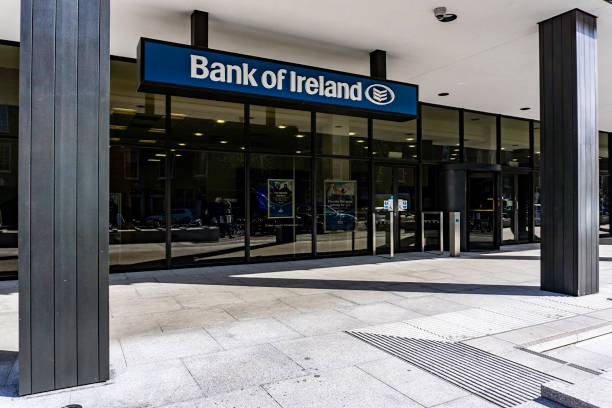
I am prepared to admit that in the past, now I’m talking about back in the 20th Century, way before the bail-out, the banks may have had too many staff and their costs may have been too high. A certain amount of rationalization was required. But surely there is only so far that you can cut costs? You must reach the point where you say – enough – our costs are now at an acceptable level. Any junior economist or intelligent seven year-old will tell you that if you persist in flogging a dead horse, you will reach the point of diminishing returns.
In my view, the Irish banks have gone a long way past that. Bank branches have been closed throughout the country; even in branches that are still open, service is minimal; you will see queues (usually of older people) which would make you weep. In a supermarket or a coffee shop or any normal business, when a queue reaches a certain level, another check-out or service point is opened. Not so in the banks; even though they may have staff available, they have told me that their masters do not allow them to open more than one cashier point. Obviously the strategy is to push people away; surely the antithesis of good business practice. I hasten to add that I find no fault with banking staff who have always been polite, but they can only operate within the parameters which have been set by their bosses. Here are a few examples:
1. Any slightly complex, in-person query cannot be dealt with at all.
2. I cannot lodge money to my account or make a withdrawal unless my account is with the bank and at the branch I am in.
3. If I am trying to lodge cash, I am almost treated like a criminal, with numerous questions as to the source of the funds – the statement, ‘oh we are required to ask because of money-laundering legislation’ is over used as an excuse.
4. If I require foreign currency, I must order it a week in advance. Alternatively, I have been advised to ‘try the post office.’
5. There is a bank branch in Blackrock, Co Dublin which is ‘cashless.’ Surely this is the antithesis of a bank?
Who would have thought that banks would want to drive customers to their erstwhile competitor? But they do – it appears that the big banks only want corporate customers.
It even goes beyond the branches. AIB have devised a system of answering phone queries which effectively brings you round and round in circles. After making a call, you will have a long wait, during which you will be asked if you wish to deal with an AI chat bot. If you decline that, you will have to listen to a repeated message saying: ‘please hold the line; we are experiencing a higher than usual volume of calls.’ Don’t believe them – this message is always on. They just don’t employ enough staff to answer the calls. When you do eventually get through – my shortest time is twenty minutes and my longest over an hour, you will be greeted by, to be fair, a very polite young person who will ask you to send an email to an address they will give you. After you do this, you will receive an automatic response stating that they will get back to you. After about a month, they will respond, always with a letter which is always unsigned. In my case, the letters were totally confusing and did not appear in any way to address my query. The letter will say that if you are unhappy with the way your query was handled, then you can call the AIB help- line; yes, you’ve guessed it; the same number where you started. So you go through the same tedious process again and eventually you ask the nice young person to connect you to the team who handled your query. Ah, but they can’t. These people do not answer calls; they do not answer emails; they are seemingly hidden away somewhere with no contact with the outside world. Your only option at that stage is to make a complaint. When you do, you wait another month and you receive a polite letter stating that there is nothing they can do. The whole point of the exercise, in my view, is to make the customer so frustrated that they just drop the query.
But I digress; I want to revisit my point about diminishing returns. If the banks don’t want retail customers, they should just come right out and say it, and we will ‘try to’ go elsewhere. The fact though, that they were bailed out by the Irish taxpayer, as I’ve said: you, me and the man-in-the –street, suggests to me that the Government should intervene and compel them to offer a reasonable service. We have the Central Bank and the Financial Ombudsman so there is plenty of regulatory ammunition, if we just choose to use it.
Although the main banks now have new owners, a significant number of the people who got them into the financial mess remain. Many have argued that if we do not punish those that were responsible, the same mistakes would be made again and again. Looking at the subsequent fines meted out by the Central Bank, there appears to be some merit in this statement. Interestingly, no group of people has ever been held to account for bankrupting the country. This won’t happen now so it is a moot point.
What could be a greater worry is if we have another recession. I should really say when as everything goes in cycles. Hopefully the next recession will not be as severe and our financial institutions won’t require rescuing again.
I’m all for free-market economics but if companies are charging for their services, they are surely required to provide those services to their clients. If they don’t, the Government should nationalize them and provide it themselves.
People are not asking for much. We are even prepared at times to use chat bots and other AI tools. But faced with a complex financial issue, all people want is a real person – a friendly face – someone who will guide them through the mire of financial bureaucracy. At the moment, those people are not there. Banks have long reached the point of diminishing returns. People abhor visiting a bank branch and would have long ago closed their accounts or changed to a different financial institution if there were one. Unfortunately our only choice is this duopoly. Returning to Government terms and conditions on the bail-out – there appears to be more than a hint of truth in the commonly held belief that the way it was handled was between friends with the exchange going: ‘here’s a few bob to help ye out lads, give it back when you can and in the meantime, sure work away'… It is a sad indictment of financial services in Ireland in the 21st Century.


Comments