Morocco – well worth visiting:
- Dec 17, 2025
- 9 min read
Updated: Dec 23, 2025

I haven’t written much recently as I’ve been travelling a lot. So I thought another l blog might be a way to get back to writing. I recently spent a week in Morocco. Starting in Agadir, I hired a car and visited Essouira, Marrakech, Casablanca, Meknes, Volubilis, Fez, then took an 800km trek across the Atlas Mountains to Ourzazate, on the edge of the Sahara. From there to Ait Benhaddou, Tarradount and back to Agadir. I possibly took on too much for a week but I got there and saw everything I came to see.
So, impressions – firstly, if you are hiring a car, the road network is superb, surprisingly so. There are fine modern motorways between the larger cities with regular service areas. Other main routes are almost all dual carriageways and their two-lane roads are very good also. The only place I encountered poor roads was in the High Atlas and here, it was because they had been damaged by landslides and were under repair. Now, if you’re a nervous driver, I wouldn’t recommend you go up there as mountain roads are quite twisty and narrow and barriers are rare; so stick to the main roads. But if you are brave enough, you’ll be rewarded with spectacular scenery.

People in Morocco are incredibly friendly and welcoming and will go out of their way to help you. I understand crime rates are very low and you will feel safe everywhere. Because the country is a former French colony, most people can speak French and a considerable number of people also speak English so there is no problem in communicating. There is also an excellent 4G phone system with coverage everywhere.
The country is relatively cheap for a European. I paid 78 euro for a week’s car hire; my accommodation (B&B) averaged 25 per night; the max I paid was 31 and the minimum 16. The quality of the rooms was excellent as was the breakfasts. I had only booked one hotel in advance as I prefer to wait until I find a town or city that I am comfortable in and then seek accommodation. Now, I was using the booking platforms on the internet which are fine but I was assured by people I met that accommodation could be had for a fraction of what I was paying. I met a Polish couple who had been there for a month and the max they had paid for a night (for two) was e14.So, if you have time, shop around. I should mention that Morocco has different types of accommodation. I stayed in hotels and ‘Riads,’ which are the Moroccan equivalent of air B&B’s. They are generally very good and many offer a package including dinner, bed & breakfast. One point to note for the driver – they are very difficult to find using sat nav. They are usually located in back streets, often in pedestrianized areas, so are not really user friendly for the motorist.

The quality of food in Morocco is generally good and prices are about half of what you might pay in Ireland. A couple of things to beware of though: If you want wine (or any alcohol) with your meal, you may have to do a bit of research. In Agadir, as it’s a sun holiday resort, there were plenty of good restaurants serving alcohol, but in my experience, not many in the rest of the country. They can be found of course but they tend to be a bit more expensive. Another thing to note – bring plenty of cash; people don’t want to accept credit cards in restaurants. In fact, they don’t like them anywhere. I had to pay cash for food, drink, petrol; even some hotels wanted cash. I think I only used my credit card twice in the week and one of those was in McDonalds.
But enough of the travel hints for now. Moroccans are great traders and will sell you anything. Cynics would say this is why they are so friendly, because they want you to buy something, but it’s not entirely true. I saw wonderful enterprise and a people willing to work at anything to earn a living. I understand that there are not many social supports so it’s understandable. One of the things which fascinated me was the baristas. Obviously Morocco hasn’t escaped from the boom in drinking coffee that seems to be everywhere these days. But here they’ve taken it a stage further – on every road, you’ll find guys with vans fully equipped with proper barista machines selling excellent coffee. They seem to universally charge ten dirhams which is equivalent to one euro. Apart from coffee, every small town and village has its own ‘souk’ where you can buy a wide variety of local merchandise. I mentioned earlier that the motorways have modern service areas with cafes and restaurants. The lesser roads have something that was unique to me. You would see a sign advertising ‘Restaurant.’ There would be tables and chairs and possibly one staff member but no menu. Off to the side would be effectively a butcher’s shop. This would be fully stocked with sides of beef and lamb, offal and various other cuts. You select which piece of meat you wish to eat; the butcher cuts it for you, then passes it to a guy in the next stall, who has a barbecue working. The meat is cooked to your taste and potatoes and salad are added. You end up with a delicious meal even if the preparation of it was somewhat unorthodox. I have not seen this practice undertaken anywhere else.

But back to their penchant for enterprise and unusual ways of making a living; I already mentioned that satellite navigation is not ideal for finding a place in an older city, certainly not one with narrow streets and areas which don’t allow cars. Enter Marrakech, which, to put it mildly, is a bit of a madhouse. I don’t mean this in a derogatory way, far from it. The amount of life in the city, particularly in the evenings is awesome. But first you must get there and thereby hangs the origin of this tale: I arrived in Marrakech around 5pm, which I guess was rush hour so I was at a disadvantage from the outset. I had booked a Riad (small guesthouse) close to the city centre. My sat nav guided me to the general area but then continuously told me to ‘turn right.’ This wasn’t an option because all the streets prohibited cars. After asking me to turn down at least 20 of these streets, I had probably completed a full circle of the city and was no closer to my Riad, and of course I was hopelessly lost. Once, I chanced going down a street and immediately encountered a policeman who told me I shouldn't be there. He was very polite, helped me to turn around and go back. But he said to me that the best thing I could do would be to go park the car somewhere and get one of the young lads on a motorbike, who were everywhere, to bring me to my accommodation. I thought about his suggestion, given in good faith, but I had no wish to abandon the car some place where I’d never find it again. So I kept driving around trying to find the place and eventually I came upon the same street again, that was closed off. This very polite gentleman walked over to the car and he says, ‘excuse me, sir, but you cannot enter this street and you would appear to be lost.’ I said I certainly am. So he asked me which street I was looking for. I told him the address, and he said ‘yes, I know where that is, but it’s a long way away from here. If you wish, I can go with you and show you.’ I agreed and so he sat into the car. The guy's name was Mustafa. He spoke perfect English, as well as French, Arabic and his own Berber language. He told me he makes his livelihood helping tourists that are lost – incredible. He just hangs around and he sees people lost or confused. Now there’s any amount of people to help because the back streets in Marrakesh are just a total nightmare. Some of them you can bring a car into but they are extraordinarily narrow. The entire area is just a riot of small cars, motorbikes and bicycles just flying in all directions. On the drive from where I met Mustafa to the point when I eventually found the Riad in which I was staying, I'm sure we killed about 20 cyclists and motorcyclists and dozens of pedestrians. I speak metaphorically of course; we didn't kill anybody, but it seemed like we were just avoiding them by a hair's breadth and they were flying in all directions, but Mustafa was totally calm. I was turning the air blue with my comments at every close and even closer encounter but to him, it was just another day at the office. After about twenty minutes of crazy driving, we found the accommodation. He found me a place to park and ensured I gained access to the Riad. I obviously gave him a generous tip and he was on his way, off to re-direct another misfortunate tourist. ☺ But good luck to him – he provides a service. Interestingly, he’s not the only one as he was about the fifth or sixth guy who had approached me. I didn't take up the offers of the others because I didn't like the look of them but in retrospect, I’m sure they were fine.

Having settled into my accommodation, I chatted with the landlord who showed me how to get to the city’s central square. After my traumatic drive, I momentarily thought of staying put for the night but after a while I said I’d try it. I wasn’t disappointed; the walk from there into the center of Marrakech was a complete riot. I'd have to write a separate article to describe everything. Marrakech is an incredible place; all human life is there. If the streets I traversed earlier were narrow, these ones were narrower still and they were absolutely crammed tight with people and motorbikes and cyclists. Incredibly, guys just come flying along on a motorbike into an area with thousands of people. How they avoid accidents and how they don't kill people. I don't know; it’s frightening stuff.

But then, after about half an hour navigating through this nightmare, the central square emerges; to say it was a shock to the senses is an understatement; it was a huge vibrant area thronged with, as the song says, shiny happy people. It was crowded with musicians, dozens of different groups all making music and song; dancers; entertainers; street vendors selling everything imaginable; the food vendors alone took up an enormous area. Every possible type of food was on sale and you could eat-in or take-out. The square is enormous, probably a square mile in area. I won’t attempt to describe it further; it has to be experienced for itself. Suffice to say I spent several hours there, soaking up the atmosphere and chatting to many of the locals. The place was manic but it was a Wednesday evening and I was assured that it was far busier at weekends. ☺ Where they could possibly fit more people is beyond me, but to conclude, I would say Marrakech is unique.

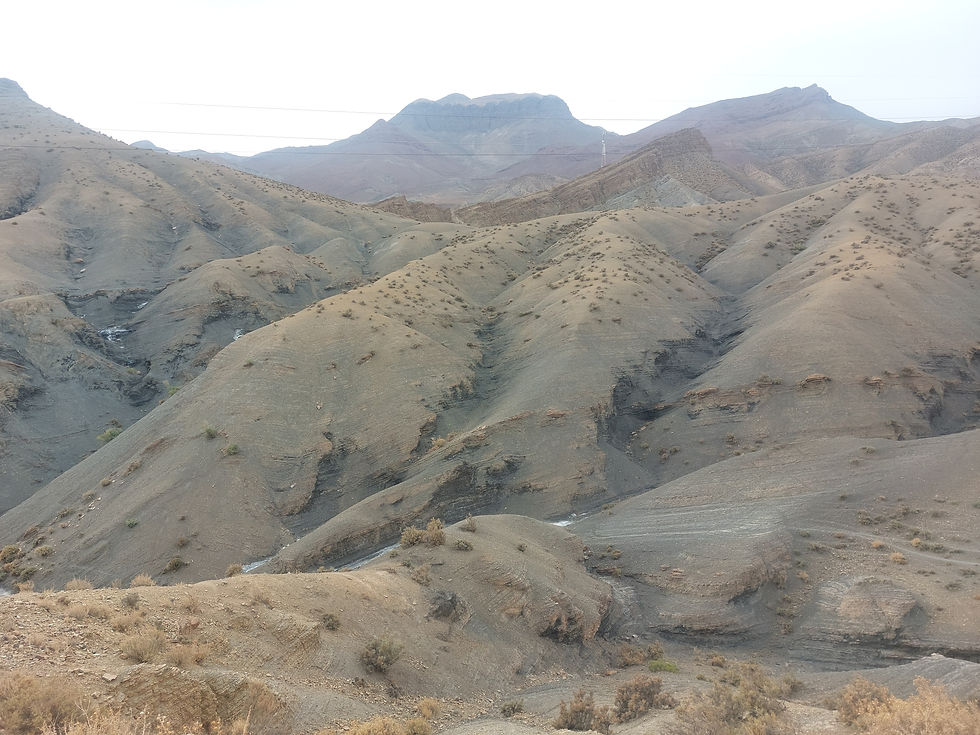
After that, the rest of the country was quiet, but nonetheless very interesting. The old Berber towns of Meknes and Fez are fascinating and with their narrow streets with barely room for two people to pass, have to be visited on foot. I didn’t mention that Morocco is 31% Berber and 69% Arabic, although it is said that there is some Berber blood in over 70% of the population. Likewise, the ancient Roman city of Volubilis is amazing; much larger and featuring more artifacts than many similar ancient cities that I have visited. The Architecture is outstanding for the time. Essouira is also worth a visit maybe for a day trip. I loved the journey though the Atlas Mountains but give yourself more time for this than I did. ☺ I went all the way from Meknes to Ourzazata, on the edge of the Sahara, in one day Ourzazata is a nice town but I preferred the trek the following day through the desert and the various oases, the highlight of which was Ait Benhaddou. The roads through the desert were two-lane but again, very good. Morocco earns a lot of revenue from tourism and obviously reinvests it in infrastructure.
One or two things to be aware of: I mentioned that people are friendly and helpful and they are but some are too much so. On two occasions, people who claimed to be ‘guides’ attached themselves to me even though I hadn’t asked them and I made it quite clear that I didn’t need a guide. Unfortunately they didn’t take the hint. I did give them some money when they eventually left but they were not happy with it, even though I felt it was generous – so be careful. Also, if driving, beware, the country is awash with traffic police, some of whom are intent on lining their own pockets, with fines levied for real or imaginary offences. ☹ And finally, when leaving the country, be aware that Morocco has more departure checks than any country I have visited. For a start, they will only accept paper boarding passes so if you check-in on-line, you will need to print your boarding pass; electronic passes are not accepted. Why there are so many checks is beyond me; it reminded me to some extent of the old Soviet Union, where the system was designed to keep foreigners out and keep their own people in.

But these are minor inconveniences. Morocco is well worth a visit and has something for every type of tourist, from the sun destinations in the west to the ancient Berber villages and the mountains of the interior. But remember to bring plenty of cash.☺


Comments