Hurling's Best Ever?
I have written a lot of stuff recently, having discovered many old drafts that I had scribbled over the years but not finished. Allow me therefore to write about my favourite subject – hurling. For non-Irish people, this is one of Ireland’s national games, an ancient sport which goes back over 5,000 years. It is played with a ball and a hurley stick and you can score goals and points. It is without question the fastest and arguably the most skillful field sport in the world.
You very rarely get a poor game in hurling. The game is so exciting and features so many skills that it is a delight to watch any time and most games are highly entertaining. Each year there is a competition to decide the best hurling team. The final is called the All Ireland Final. While the game is played in all parts of Ireland, only about ten of the thirty two counties would be competitive enough to have a reasonable chance of winning the final. In Fact, in the 140 years since the first final was played, there have only been 13 different winners. My own county, Kilkenny, even though it is one of the smallest in terms of population, have won more titles (36) than any other county.
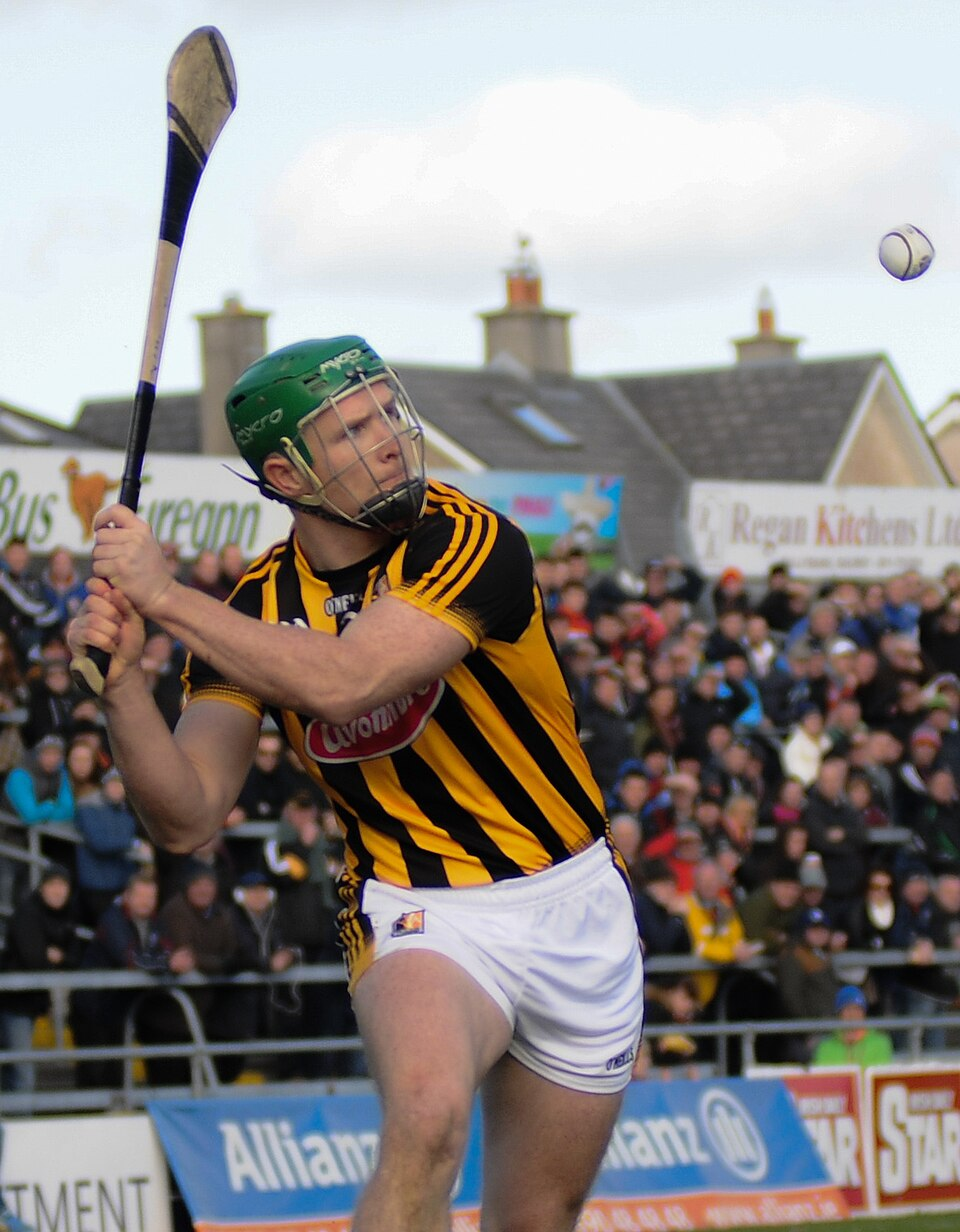
You can guess therefore that when I say hurling’s best ever that Kilkenny are going to feature. I’m not going to get into a debate about who was the best hurler or which was the best team because such arguments are futile; everyone has their own favourites and everyone is entitled to an opinion.
What I am going to write about is what I would call the best hurling occasion I ever encountered. I think anyone who was there, regardless of loyalties would agree that it was something incredibly special. Now there had been some epic games and finals in the previous years and there have been some fantastic games since. While this game was only a back-door qualifier in the early stages of a championship, it was for me, the best atmosphere I ever encountered at a game anywhere and I have been to stadia around the world to watch football, rugby and many other sports. I was not alone; Des Cahill, the well-known and popular RTE broadcaster said he has never encountered an atmosphere like it at a GAA game.
I will set the scene: It was 2013 and Kilkenny had arguably their greatest ever team; they certainly had their greatest ever manager in Brian Cody. They had won 9 of the previous 12 All Ireland titles, a number completely unprecedented and unlikely ever to be equaled, let alone surpassed. Starting 2013 as champions, they were once again favourites. However, there was a problem – several problems in fact because as the championship got underway, many of the key players succumbed to injury. Two former hurlers of the year, Henry Shefflin and Michael Fennelly, were out and they were just two of many.
In those years, if you lost a championship match, you weren’t out completely but you had to play what was called ‘a back door’ match the following week. In late June, riven by injuries, Kilkenny lost to Dublin and therefore had to go into the open draw for the back door game the following week. As fate would have it, Tipperary, Kilkenny’s greatest rivals, had been beaten the previous week also. Now these were, when at full strength, arguably the two best teams in the country. Kilkenny had been champions in the two previous years, 2011 & 2012. Tipperary had been champions in 2010, beating Kilkenny in a match where they had been aiming to win five titles in a row, a feat never before achieved. Fate intervened and when the draw was held, the two counties had to face each other. The thought of the two best teams in the country meeting in a straight knock-out game on 6th July was thought by many to be a pity. In those days, the championship final was in September. But if you lose, you have to accept the consequences so there were no complaints from either county.
In the open draw, Kilkenny had come out of the hat first so they were given home venue. Tipperary’s home ground holds 55,000 but Kilkenny’s Nowlan Park only holds 25,000. The game sold out within minutes and I was lucky to get a ticket. But that was only the first step. The stadium in Kilkenny does not have numbered seating so in order to get a reasonable spot in which to watch the game, patrons usually arrive early. On this beautiful balmy evening, the game was due to start at 7pm but the ground was completely full by 5pm. I wasn’t the only one to come early but I did manage to get a good seat.
The excitement was palpable and the atmosphere was electric. The game would be broadcast live on TV and apparently generated a huge audience for an evening hurling game. The media had billed is as ‘Cody’s last stand.’ Brian Cody had been manager for over a decade and his teams achieved so much through sheer defiance, refusal to lose and a never-say-die spirit. Presumably the epithet was adapted from ‘Custer’s last stand?’ Well General Custer may have had Lt William Cooke but Cody had Paul Murphy. One of the most under-rated hurlers, Paul quietly went about his work with the absence of fuss; as Con Houlihan used to say, the true mark of a genius.
On this occasion, it was even more remarkable because Paul had suffered a serious ankle injury two weeks before and was expected to be sidelined for months. How he played I don’t know but he rose like Lazarus and dominated the game. While nominally selected at corner back, he covered every inch of ground and locked the defence together. This was from a man who had barely been able to walk a week before. But it didn’t stop there. Henry Shefflin, also seriously injured, made a cameo appearance designed (by Cody) to lift the players over the line when they were struggling. Henry was only half fit but he still managed to make a point for Richie Power with a few minutes to go that broke Tipp hearts.
To be fair, the game was extraordinarily competitive throughout; Tipperary scored a goal from one of their best players, Lar Corbett, early in the game and were leading for a time. However, Lar succumbed to injury soon afterwards and had to leave the field. There is no doubt that it reduced Tipp’s effectiveness but to be fair, one of Kilkenny’s superstars, T.J. Reid had had to leave the field earlier with another injury. The game ebbed and flowed and was close throughout with Kilkenny just edging in at the end 0-20 to 1-14. All thirty players and the substitutes used on the night gave everything. It was an epic in the true sense; it may not have featured spectacular goals or indeed a very high score but that was down to the sheer do-or-die nature of the defending on both sides.
When the game was done, the camaraderie; the friendships that had been wrought over many hours of battle were there to see – men who had been foes until a minute beforehand embraced and wished each other well. Even amongst the supporters, the sportsmanship was apparent. There was universal agreement that we had all witnessed something special and that the better team had triumphed on the night.
This was the game that had everything – never, in over 50 years following Kilkenny have I seen such unbridled passion. In fact, what I witnessed, I have not seen in any sport: A standing ovation for the team when they took the field; a standing ovation at half time, for both sides, and a standing ovation at the end for the winners. Was it the do-or-die nature of the contest; was it the fact that one of, arguably the two best teams in the country would be out of the championship so early? Did people think that this was the end of empire? Possibly; I had some doubts myself; but Cody hadn’t; neither had Paul Murphy or the rest of the team.
This was not the stuff of drama – for no dramatist dare write such a script. No, this was beyond drama – a defiance built from sheer courage in the face of adversity. This was the game. This was the place to be. This was the moment that defined Kilkenny hurling in the Cody era. This was the quintessence of what Cody built. The sheer defiance; the spirit – the refusal to cede to history – to allow what everyone felt was the natural order – the pure raw courage and strength.
Walking the pitch afterwards, people treaded lightly; it was almost as if they felt they were walking on sacred ground. Was it theatre? Was it poetry in motion? Perhaps both, but one word sums it up for me – Magnificent. Even though Kilkenny were ultimately beaten in the quarter final that year, it didn’t matter. We had won plenty and we were satisfied and we had witnessed something special on the 6th of July 2013.
Footnote: Both Kilkenny and Tipperary recovered and contested the All Ireland Final in 2014. Kilkenny won after a replay. The drawn match, with a score of 3-22 to 1-28 was probably the best final I have seen.


Comments