Greece — another sort of travel blog
- Dec 15, 2025
- 7 min read
A few years ago, while on a solo trip through southern Europe, I found myself in the south of Bulgaria on a Friday afternoon when I realised that the All-Ireland football final was taking place on the Sunday of that weekend. Dublin were playing Kerry and going for five-in-a-row and I was anxious to see it. So, I googled Irish pubs near me, and the nearest one I could find was in Thessaloniki, which, of course, was across the border in Greece. But that wasn’t a problem. It was a relatively short drive and as I crossed the border, I realised it would be the first time I visited any part of Greece. I very quickly realised what an omission that was as I was enchanted by the magic of the country very quickly as I realised how much it had to offer. I have subsequently seen a little more of it and have been very impressed with every facet — its scenery, its culture, its food and drink and of course the wonderfully friendly Greek people.
But back to my story: I found my Irish bar and had a good evening and a great weekend, made some new friends and watched the game in comfort. On the Saturday, I was recommended to visit the sights on both sides of the gulf of Thessaloniki including the many national parks in the area. The scenery was magnificent and I found myself saying, if this is what a relatively unknown or remote part of Greece is like, then the parts which are better known must be out-of-this-world.

On the Sunday, match day, one of the friends I met was a young guy, and he spoke to me about a place called Meteora, which I had never heard of. Although he was only in his 20s, he had travelled quite a bit, and he told me that this was the most fabulous place he had ever been to. He didn’t tell me anything about it. He said, ‘I’ll let you judge it for yourself,’ but he strongly recommended I go there. So, the following morning, as I still had a few days left before I was due to fly home, I went to Meteora. It wasn’t that far, maybe a three-hour drive and the scenery on the way was beautiful, with winding roads through the mountains offering great views. And boy, was he correct. I was awe struck. Similar to what my friend said, I had never seen a place like it anywhere in the world.
Now I realise this is a travel blog about all of Greece but first I must describe Meteora. It is a series of high mountains all closely gathered together (some would say huge rocks), each of which has a church and a monastery built on top of them. When you first view the scene, you wonder how they were built at all because the walls of the rock face are sheer and virtually vertical. Nowadays there are steps up to each one and while they are challenging climbs now, back in the days when they were built, those steps did not exist so they are miracles of engineering and perseverance and, quite probably, faith. In Ireland, monks built round towers with very high doorways through which ladders could be pulled up so as to be safe from invaders. Most of these date from the 9th to the 11th Centuries. The monasteries at Meteora were, I believe, built between the 14th to the 16th Centuries. One assumes they were built for the same purpose — protection from invaders, but on a much grander scale. When you reach the top of one of these mountains, you realise the monks who lived there constructed what was almost a small town on top of each rock. Needless to say, the entire place is a UNESCO world heritage site.
Speaking of, perhaps the most famous world heritage site in Greece is the Acropolis in Athens. Greece is spoken of as the cradle of civilisation and the Acropolis certainly shows what the Greeks were capable of thousands of years ago. I’m not so sure the Chinese would agree with the sentiment though as they claim to have had an even more cultured society hundreds of years beforehand. Nevertheless, the Acropolis is a testament to Greek architecture and engineering, built long before the Romans began to dominate. A short drive from Athens is Delphi, which apparently was considered by the Greeks to be the centre of the ancient world. Situated on the slopes of Mount Parnassus, Delphi is another engineering and architectural feat but probably more along the lines of the ancient city of Ephesus in Turkey. Obviously Meteora was my favourite but the others are also well worth visiting.
I call all of my travel tales ‘sort of’ travel blogs. That is because I can never cover an entire country and can only give my impressions of the parts I visited. This is particularly true of Greece and in particular, the Greek Islands. There is so much to see in so many beautiful places that you would need to spend many months if not years to see them all. Apparently, Santorini, Mykonos and Corfu are among the most popular and the most visited. Unfortunately, I haven’t been to any of them so my island blog will be confined to Crete and Rhodes.
I drove around the entire island of Rhodes in one day and at the time, in Summer of 2023, some of it had just been destroyed by wildfires. Nonetheless it was beautiful and well worth seeing. As I said, you can see it by car in a day but you can stay longer and spend a day in the mediaeval city of Rhodes, visit the acropolis of Lindos and walk through the magnificent ‘Valley of the Butterflies,’ where there are ancient rock formations, waterfalls and streams, all featuring millions of butterflies. How or why the butterflies congregate there is beyond me but it is a wonderful sight to behold.
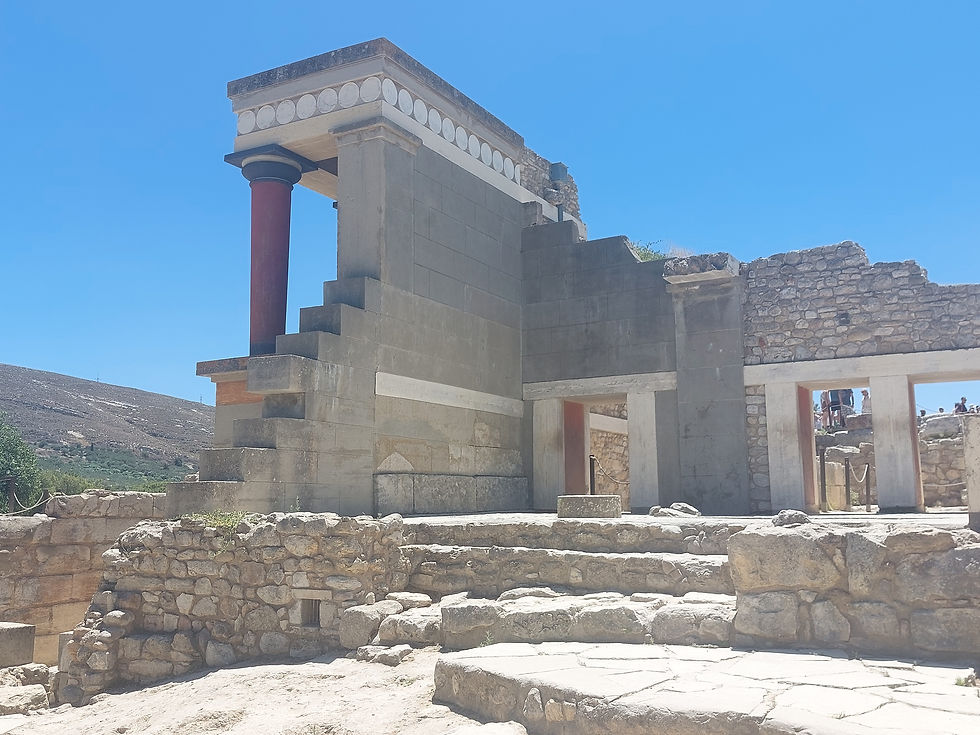
Crete is a much larger island and we spent about ten days driving round it. There are so many interesting places to see that it’s hard to know where to start. We flew to Heraklion and effectively drove around the entire perimeter of the island, heading inland occasionally to climb Mount Ida or as the Greeks call it Psiloritis. This mountain is 2,500 metres high but luckily there are roads that climb most of it, only leaving the final 300 metres. But starting with Heraklion, we visited the Palace of Knossos, the largest Bronze Age archaeological site in Greece. This Minoan palace comes with a big reputation but to me was disappointing. I guess they haven’t excavated enough of it yet for it to compete with the likes of Delphi or Ephesus. From there, we went to the Samaria Gorge, located in the White Mountains. This 16-kilometer-long gorge takes five hours to walk from the top to the bottom, where you are collected and returned to your starting point. I have no idea how long it would take to walk up it and I didn’t ask. The gorge is very impressive and the walk offers beautiful landscapes, diverse flora, and opportunities to spot unusual wildlife. The trek concludes at the picturesque village of Agia Roumeli, where you can relax by the Libyan Sea with a few glasses of delicious Greek wine before returning. Of course, if you don’t want to walk the gorge or don’t have the time, it is still worth visiting and viewing from the top.
Now, speaking of wine, I’ll digress at this point. Everywhere in Greece, the food and wine are delicious and extraordinarily good value. You don’t get many Greek wines exported so I had only ever tasted a few. We mainly kept to local wines in wherever we stayed and a decent sized carafe of red or white could be had in any restaurant for about five euro. The cuisine is also excellent and very reasonably priced.
But back to Crete — from Chania, on the north coast, we drove right around the coast road all the way to Frangokastello on the south coast. You can easily do the drive in about five hours but if you want to stop often to take photos and appreciate the beauty of the landscape, as we did, it will take much longer. But it is worth it — for me, definitely one of the most scenic drives in the world. From there we spent another day driving east through all the little towns and villages, occasionally stopping for a coffee, a bite to eat or just to appreciate the beauty of the place. We went as far as Xerokampos on the east coast and then headed north to the pretty town of Sitia. The drive here through the high mountains is also outstanding and a must visit if you are on Crete.

Possibly some of the best sites were yet to come as we spent a few days in the small town of Elounda on the north coast and visited the famed island of Spinalonga, which is a former leper colony. The island is uninhabited but has been largely restored and is an architectural gem.
There are so many other beautiful islands but, as they say, so little time. I do however intend to visit some of them and hopefully blog about more memories. A final thought — as you plan your journey to any part of Greece, be flexible and leave some room for spontaneity. Although Greece is famed for its numerous ancient buildings and archaeological sites, perhaps the real magic of the country lies in the warmth of the locals. With its rich history, natural beauty, and welcoming people, Greece is a travel destination that will win you over and possibly enchant you. I know people who return there again and again. One small word of advice — embrace the Greek way of life, don’t be in a hurry, don’t rush, appreciate the beauty of nature and the wonderful landscapes and beautiful weather. That’s not to say service is slow in Greece, but perhaps sometimes a little more relaxed than elsewhere.


Comments