Azerbaijan - a land of contrasts:
I visited Azerbaijan in late summer; well it was September but it was still up to 30C most days and the skies were pristine blue. I think summer there probably runs well into October. The country’s best features for me are its mountain scenery and I reckon a lot of the high mountain passes would not be navigable in winter.

The country is not a mainstream tourist destination and is unlikely to become one for some time. It is a land of contrasts. In the capital, Baku, you could be in any modern city — in fact, the business and retail district would remind you of central London or even New York. But when you go out to the country areas and visit the small towns and the villages, you could still be in the Soviet Union, which of course Azerbaijan was part of until 1991.
I’m not sure whether this is a plus or a minus? It has its attractions but also its limitations. One thing I must say from the start though — Azerbaijani people are extraordinarily friendly and welcoming. In the eight days I was there, everyone I met was helpful and pleasant. I have a friend from Azerbaijan whom I worked with in Russia who told me that I could call to any home in Azerbaijan and ask for a cup of tea. He assured me that not only would I be given tea but I would be fed and they would ask me if I wanted to stay the night. I didn’t test his theory but I will say that in the two guesthouses I stayed in, I was greeted warmly and offered tea or coffee and cake as a welcome. It evoked for me the days when you would check into a B&B in the west of Ireland and immediately be offered tea.

But let’s go back to the travel blog thing and start at the beginning. You will need a visa to enter Azerbaijan but it is easy to apply for one on line and it is delivered within two days. No problem there but when you arrive, be prepared to wait at Immigration control. The evening I got there, the queue was massive and it took over an hour to get through. It reminded me somewhat of the old Soviet Union. The next thing that caused an issue was a minor administrative error but in a rigid system, there is probably no such thing as a small error. The problem was this: The expiry date on my passport says the sixth of February 2033, but whoever issued the Azerbaijani visa typed the sixth of March 2033. Obviously I didn’t notice that there was any difference, but the Immigration officer did, and initially said I couldn’t enter because there was a minor discrepancy between my passport and the visa. I explained that the fault was not mine but that of whoever issued the visa. She eventually agreed to go to somebody more senior, who had to go to somebody more senior still, and eventually they did let me enter. So be sure to check your visa before you travel and ensure it precisely matches your passport.
My next issue was that my car hire representative was not where he was supposed to be. When I eventually located him, he charged me an additional E50 because I was over 65. Strange — you usually get a discount as a senior. This was the first of many issues I had with the car hire firm who were determined to take as much as they could from me but more of that later. All I will say at this point is that should you wish to visit Azerbaijan, don’t hire a car. I hire everywhere and my experience here was the worst I have had. Go on a tour or get a bus or a train — don’t drive yourself.

I eventually got my car but the experience was not a great first impression. My second impression was even worse. When I arrived at my hotel, my reservation had been canceled, despite the fact that I had confirmed it both by email and by what’s app. The manager said he had cancelled it because he gets loads of fake reservations or reservations where people don’t turn up, and he has to cancel them. The guy is obviously paranoid because he had contacted me on the 29th of July and asked me was I genuine, and I said yes I was, and he gave me a WhatsApp number and phone number to contact them, and we had a long conversation on that, during which I actually made a second reservation for the following week. Unfortunately he’d forgotten all about this, and he’d canceled my reservation for no particular reason. The hotel was full so there was no room.
I was quickly forming the impression that this is a country full of bandits. It isn’t. I drove only a short distance to another hotel and while it was also full, the manager called round other hotels and got me a room. He even insisted on carrying my bags to the hotel which was close by. I think both he and the check-in agent in the other hotel were embarrassed at the way I had been treated and went out of their way to help me. The hotel was great and was a taste of things to come as I found the standard of hotels throughout Azerbaijan to be superb and extraordinary good value. I paid an average of around E25 per night for four star properties. I could have paid even less had I chosen two or three stars. The price included a very good breakfast and here’s the clincher — even though I was alone, the price was for two people. I joked with some of my hosts that I should eat two breakfasts. :)
Let’s deal with cost at this point. Almost everything in Azerbaijan is cheap by European standards. Apart from hotels, meals are very reasonable — a three course dinner with wine or beer costs on average E15. The only thing I noticed which was in any way out of sync was the price of a cup of coffee. Like the rest of the world, Azerbaijanis are hooked on the bean and coffee shops proliferate. Unfortunately, the cost was about three euro. This is completely at odds with the price of everything else. If it were good coffee there would be some justification but in many instances, it was instant. Now, I hasten to add, it is only a small complaint. The coffee shops featured an array of pastries and savouries which could be had for half the price of the coffee.

Naturally, there are many cultural differences in Azerbaijan. This of course is fine and is actually the reason why many of us travel to distant and different places. We want to experience life in different societies with different systems, values and culture. For instance, although Azerbaijan is a secular society, most of its people are Muslims so you won’t find any bacon for breakfast or ham sandwiches for lunch. That said, the food is very tasty — it has strong links to Turkish and other Caucasian nation foods. I‘d recommend the pies and stews and dishes cooked in earthenware, not to speak of the infinite variety of kebabs.
I mentioned at the outset that for me, the best parts of the country are its high mountains. I drove from Baku to Quba in the Caucasus Mountains. From there I went up the dramatic gorge road to Khinaliq where the scenery is breathtaking even if the mountain roads are narrow and of poor quality. The drive to the village located at 2,500 metres is only about fifty kilometres but takes at least two hours without stops. It took me six hours there and back — such was the magnificence of the scenery, I just had to keep stopping the car to view it and to take photos.
On the way back I called to Shahdag mountain resort. Next morning I drove to Sheki and then on to Gabala. These also feature mountains but of a more gentle nature. From Gabala, I journeyed back into the Caucasus to Tufandag, where I took a cable car to 4,000 metres. In Khinaliq, you can drive to over 2,000 metres but not here. It’s worth it though — the views from the cable car and at the top of the mountain are spectacular. Back on the ground, the nearby Nohur Lake and the seven waterfalls are worth visiting although there wasn’t a lot of water due to the dry weather.

Next day I drove to Ismailli and followed the Quirdimancay gorge up to Lahij, It’s not for the faint hearted as there are numerous cliffs, huge drops into the gorge and narrow roads clinging to the mountainside. But the journey up to the village at the top is worth it and it was here I purchased a few mementoes as the Lahij gift shops offered excellent value. All these adventures were over the course of several days and I am only giving a brief flavour of them here.
Back in Baku, I’d recommend Fountains square, a walk through the old city and the main boulevard and if you want to go a bit further, Highland Park offers the best view in the city, overlooking over the Caspian Sea. For a little bit more adventure, it’s not far to Yanardag (the burning mountain) or to really enjoy the Caspian beaches, go to Seabreeze.
One interesting difference I noticed in all the cities including Baku was the absence of the old high rise Soviet style apartments. Of course there were some but not as many as in other former Soviet States. I have travelled through many parts of Russia and everywhere I have gone, even in the smallest town or the smallest village, high-rise apartments proliferate. They didn’t seem to know anything else — they just built high rises and put people into them. In Azerbaijan, by contrast, there are a lot of one-storey, two-storey, and three-storey buildings. Even in Baku, there is a massive amount of what you’d call low-rise accommodation and it obviously isn’t new so not everybody lived in apartments in the Soviet Union, as we were led to believe.

I did mention that I wouldn’t recommend driving in Azerbaijan so let me explain. Back in the old Soviet Union, the philosophy was to keep foreigners out and natives in and to make moving around as difficult as possible. Hence it was difficult for a local to get an exit visa and it was difficult for a foreigner to get a visitor visa. Ah, but the clincher was the traffic police. My ex-colleagues will tell you that these people were everywhere, lying in wait to catch you (and fine you) for all sorts of offences — both real and imaginary. It made driving round quite difficult and apart from the roving traffic police, there were numerous checkpoints.
Nowadays, the checkpoints are gone but the traffic police are as numerous as ever, if not more so. Whereas in the past they used mobile speed detectors, Azerbaijan now has the most comprehensive and sophisticated traffic policing system I have seen anywhere. Cameras are literally everywhere; on every road, major or minor; in every town and village, even in the remotest places. There are so many of them that it is advisable to pick the lowest speed imaginable and just stick to it because the limits can change with bewildering rapidity and for no apparent reason. For instance, you can be on a major highway where the limit is 90 kph and for some reason, the limit may decrease suddenly to 60 kph, even though there is no village or no visible presence. And rest assured all these ‘traps’ will have sophisticated cameras which will detect you from numerous angles. The police are still there too except that in the old days they drove Ladas but now all have BMW’s.
The official word is that all these systems have been installed to improve driver behaviour and reduce road accidents and road deaths, where Azerbaijan has a poor record. However, for me, it threw up an interesting paradox. Even though they have a very sophisticated system for catching drivers who break the rules, particularly the ubiquitous speed cameras and radar systems, the underlying driving behaviour can still feel remarkably chaotic.

It may seem like I’m criticizing drivers here but I’m not really. After a week of driving, I’ve found the combination of the two quite striking. There seems to be a lot of abrupt lane changing and little use of indicators; tailgating; overtaking in situations where you wouldn’t normally expect it; cars cutting across several lanes to make an exit; sudden acceleration followed by equally sudden braking and poor lane discipline. Drivers pay far more attention to where the cameras are rather than simply maintaining a sensible speed. It leads to very erratic driving and a general assumption that other road users will somehow accommodate whatever manoeuvre is being attempted.
So Azerbaijan has a highly effective system for controlling speed while still having what feels like fairly poor driving behaviour. The cameras can control something that is easy to measure objectively — speed. But they can’t easily control judgement, courtesy, anticipation or sensible decision-making. And that may help explain something in the road-safety statistics. I may even write a separate article about this as I’ve always found that over-policing a situation is inevitably counter-productive.
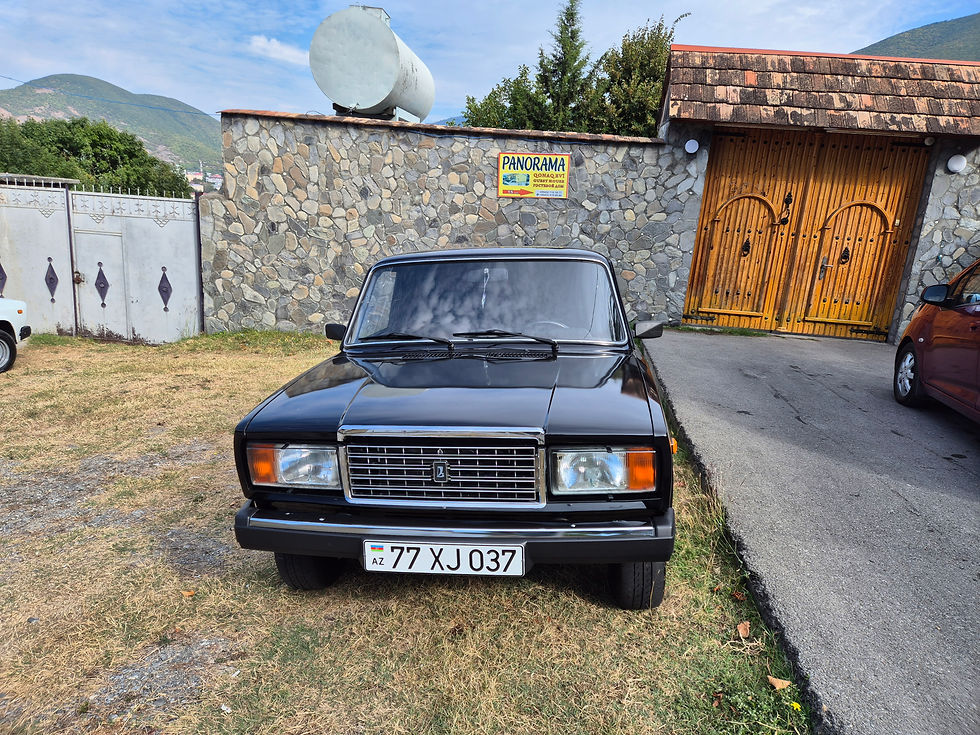
But enough of criticism; I’ll make one final observation on the traffic. I was amazed by the number of old Ladas, or Zhigulis, as they were known locally, that are still on the roads. Even more so, the amazing fact is that while most have to be at least forty years old, they seem to be kept in pristine condition. Apparently there are still 400,000 Zhigulis registered to drive in Azerbaijan and about 200,000 other Soviet era vehicles. I spoke to some of the owners and they told me the cars are simple, unsophisticated, with practically no electronics but are simple to repair and maintain and apparently are very reliable. They seem to be proud of the cars and maintain them really well.
But I’m digressing and should get back to my travel recommendations. Would I recommend Azerbaijan as a tourist destination? Yes, absolutely — if you want guaranteed good weather, sunshine and sea, endless beaches, beautiful scenery, really friendly people and very reasonable prices, this is the place for you. But go on a tour or a package — don’t drive.

How to get there: Most major European airlines have flights to Baku. There is no direct service from Dublin so I flew through Istanbul. You will find that flights are also good value.
I didn’t mention the political situation at all in this travel blog, purely because of just that — it’s a travel guide. The political situation is very stable and the country is very safe for a tourist. I’ll talk about the politics in a separate article. In fact, this trip will likely spawn many different articles on different aspects of life in Azerbaijan. Watch this space.


Comments